Statement rings look incredible on other people. But when you pick one up and slide it onto your own finger, there's a moment of doubt. Too much? Too try-hard? That hesitation is the single biggest reason people don't buy bold rings, even when they want to.

Here's the thing: "too much" is almost never the problem. Usually it's not knowing which style suits your hand, which setting it works in, or how to wear it alongside what you already own. Solve those three questions and the doubt disappears.
This is the complete guide to statement rings in the UK. Choosing one that fits your hand shape. Wearing it across every context from work to weekends. Stacking it with other rings. And picking materials that handle daily bold wear without losing their finish.
What Makes a Ring a Statement Ring?
Put simply: it's any ring designed to be the centrepiece of your hands. Distinguished by size, shape, texture, or presence rather than blending in. People notice it first.
Not every bold ring is chunky, and not every chunky ring qualifies. Slim bands with a striking hammered texture make just as strong an impression as a wide dome. Thick plain bands might not, depending on the finish. Statement is about what draws the eye, not just millimetres.
Five sub-styles make up the category, each with different energy:
| Style | Profile | Best for | Browse |
|---|---|---|---|
| Dome | Smooth, high curve above the finger | Clean modern look, solo wear | Dome Rings |
| Signet | Flat face, tapered band | Heritage feel, professional settings | Signet Rings |
| Textured | Hammered, braided, or patterned surface | Adding depth without adding height | Statement Rings |
| Stone-set / cocktail | Prominent CZ or gemstone centrepiece | Evening wear, colour, personality | Statement Rings |
| Wide band | Broad, low-profile | Subtle boldness, easy first piece | Statement Rings |
For a deep dive into the dome sub-type, including sizing (dome rings fit differently from flat bands), stacking techniques, and detailed comparisons with signet and croissant rings, our dome rings guide covers everything.
How to Choose the Right Statement Ring for You
Bold rings in 2026 aren't a niche trend. Sculptural, tactile jewellery dominates runways and street style, and statement rings are the easiest entry point because they're a single-piece commitment with outsized reward. Your hands are the most visible part of your body in daily interactions, which means one bold ring gets noticed in meetings, in photos, and over coffee without needing anything else alongside it.
But not every statement ring works on every hand. Three factors narrow the decision.
By hand shape and finger size
Wider domes and broad bands suit longer fingers and larger hands because there's natural proportion between the ring and the finger. Fill the space without overwhelming it.
Textured bands and slim signet rings work better on shorter or narrower fingers because detail creates impact without consuming the hand. For a statement ring for small hands, lean toward height or texture rather than pure width. Narrow domes and stone-set cocktail rings build presence vertically rather than horizontally, which flatters smaller proportions instead of hiding them.

By what you already own
Already wearing thin stacking bands? Add a dome ring as the anchor piece. That contrast between thick and thin is what makes a stack interesting rather than just a collection of similar rings.
If you mostly wear earrings and necklaces with no rings at all, try a single signet ring. It sits flat against the finger and feels natural even on someone who's never worn rings before. Low commitment, high payoff.
One statement ring already in the collection? Add a contrasting sub-type rather than a second piece in the same style. Dome plus signet, or smooth plus textured. Variety across sub-types looks curated; two similar rings looks like repetition.
By comfort tolerance
If you're new to bold rings entirely, start with a wide band or slim signet. Low profile, easy to type and work with, no interference with daily tasks. These pieces feel almost as unobtrusive as a thin band but carry far more presence.
Once that feels natural, go further. Dome rings and cocktail rings add height above the finger, which draws more attention but takes a day or two to get used to. Most people adjust within 48 hours. Then they forget the ring is there.
Best starting point: One gold statement ring on your index finger, worn solo. Wear it for a week. Most people who do this end up buying a second ring within a month because they realise bold jewellery is easier to pull off than they expected. That single-ring approach is statement ring styling at its most effective.
Statement Rings for Every Situation
Are statement rings too much for everyday wear? No. Not when you match the style to the setting. Learning how to wear statement rings is about picking the right piece for the right moment. A statement ring everyday is entirely achievable.
Everyday casual
One chunky dome or textured band, worn solo with bare hands around it. Simplest approach. Best approach. Simpler outfits give a bold ring more room to breathe: jeans, plain tops, linen shirts. One gold statement ring with jeans and a white shirt is one of those outfit formulas that just works, every time.
Work and professional settings
Choosing the right statement ring for work means keeping the profile low and limiting yourself to one ring. Slim domes and flat signets look polished and contemporary without pulling focus in meetings. How low the ring sits above the finger determines how professional it appears. Gold signet in a boardroom looks confident. Oversized cocktail ring looks distracting. Keep stone-set pieces for creative or relaxed workplaces.
Evening and going out
Cocktail rings, stone-set pieces, and the boldest domes earn their place after dark. Go bigger, add colour, stack if you want. Evening lighting catches metalwork and gemstones beautifully, so pieces that might feel "too much" in daylight look exactly right once the sun goes down. Silver statement ring with a black CZ against a dark outfit. People remember details like that.
Special occasions
Weddings, formal events, and celebrations call for a single piece that complements the outfit without competing. Smooth domes and clean signets work better than heavily textured bands at formal settings because they won't catch on fabric. Gold against warm-toned outfits, silver against cool-toned. Simple rules. Reliable results.
Gym and active days
Yes, you can wear a statement ring to the gym. Waterproof statement ring in PVD-coated stainless steel handles sweat, gripping bars, and repeated hand-washing without any change in appearance. For active days, keep the profile low: wide bands and slim domes work better than high cocktail rings when you're wrapping your hands around equipment. Browse the waterproof rings collection for pieces built for exactly this.
How to Stack Statement Rings
Statement ring stacking works when there's a clear pecking order. One bold piece leads. Everything else supports. Three formulas that deliver every time:
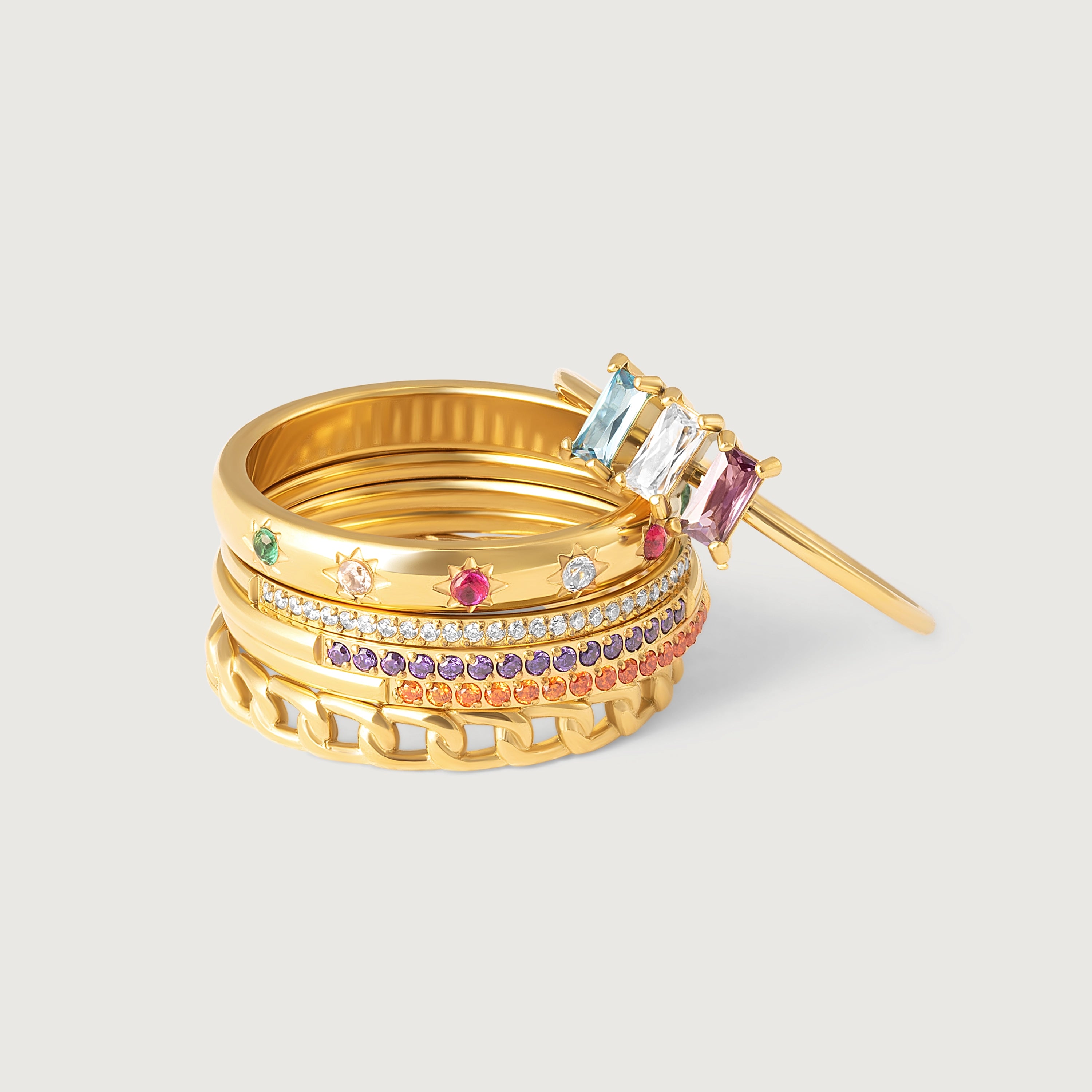
One statement ring (dome or signet) on the index or middle finger. Two thin stacking bands on the ring finger. Bold piece commands attention while the bands add texture without competition. Leave the pinky bare.
Three rings across three fingers, graduating from thinnest (pinky) to boldest (index). Creates a sweep across the hand rather than a single anchor. Works especially well with varied textures: smooth band, twisted band, dome.
One gold statement ring plus one silver stacking band, or the other way around. Metal contrast adds dimension and makes both pieces feel more deliberate. Our mixing metals guide covers how to combine warm and cool tones across all jewellery categories.
Stacking rules that actually help: Leave at least one finger bare between statement rings to give each one breathing room. Don't place two high-profile rings on adjacent fingers; they'll physically interfere with each other. Odd numbers (1, 3, or 5 rings across both hands) tend to look more balanced than even.
Materials That Hold Up to Daily Bold Wear
Statement rings face more physical contact than delicate pieces. Bigger surface area. Higher profile. More friction against tables, phones, keyboards, door handles. Every day, all day. Scratch resistance matters more here than in almost any other jewellery category.
PVD-coated 316L stainless steel with EverShield PVD+ handles this without any change in appearance. Molecular-level bond, not a surface layer. Resists scratching in a way traditional plating can't match. Six months of daily wear, and a bold PVD ring still looks like it did on day one. That matters because any wear shows immediately on a ring people are already looking at. Our gold plating durability guide explains the difference in detail.
925 sterling silver develops character through micro-scratches that many people find enhances the look of bold, textured rings. Lived-in silver signet rings and textured bands have a warmth that factory-fresh pieces don't. Trade-off: occasional cleaning with a silver cloth. For the full comparison, our gold vs silver guide covers both materials across every category.
Both materials are hypoallergenic and nickel-free. For daily-wear statement pieces, waterproof PVD means never having to decide whether to take the ring off. Showers, hand-washing, swimming, the gym. It stays on. No thought required.
Best Statement Rings by Budget
Bold style at every realistic price point. Even at the entry tier, you're getting materials that last years, not weeks.
Spending more doesn't automatically mean a bolder look. £30 dome ring in PVD-coated stainless steel will outlast and outperform a £100 fashion-plated ring that fades within months. Focus on the material inside the ring, not the branding on the outside.
Common Questions
What is a statement ring?
Any ring designed to be the centrepiece of your hands, distinguished by size, shape, texture, or presence. Includes dome rings, signet rings, textured bands, cocktail rings, and wide bands. Doesn't have to be large; it has to draw the eye.
How to wear a statement ring to work?
Keep the profile low and limit yourself to one ring. Slim domes and flat signets in gold or silver look polished and contemporary without pulling focus in professional settings. Lower profile on the finger means a more workplace-appropriate look. Our ring placement guide has more on which finger works best for different settings.
Can you stack statement rings with other rings?
Yes. One bold ring leads, and thinner stacking bands support it on neighbouring fingers. Leave at least one bare finger between statement rings to avoid a cluttered look. Contrast between a chunky piece and slim bands is what makes stacking feel deliberate.
What finger should you wear a statement ring on?
Index and middle fingers are most popular because they give a bold ring room to sit without crowding neighbours. Index finger comes across as more assertive; middle finger is slightly more understated. Both work well for daily wear and professional settings.
Are bold rings still in style in 2026?
Very much so. Sculptural, chunky rings in 2026 are one of the year's defining jewellery movements. Broader shift away from barely-there minimalism toward tactile, noticeable jewellery shows no sign of slowing. Bold rings aren't a passing fad; they represent a real change in how people approach everyday accessories.
Are statement rings too much for everyday wear?
No. Match the style to the setting and you'll forget you're wearing it within the first hour. Slim domes and textured bands are subtle enough for the office and the school run but still carry real presence. Waterproof PVD-coated pieces are ideal because they need zero thought once they're on.
One Ring. Maximum Impact.
Bold enough to carry a look. Simple enough to wear every day. Choose your statement and let it do the talking.
Shop Statement Rings Shop Dome Rings Waterproof Rings